I have had so many conversations with Technicians and Salon Owners, both individually and in groups…..everyone knows they should be promoting at home care yet, they lack the confidence to find the right words to say. Let’s start here;
Here’s something I’ve watched happen in salons for over 38 years.
A tech delivers a beautiful pedicure. The client walks out happy. Two days later, that same client is at home, ignoring her freshly serviced feet because nobody told her they still needed her. Or worse, she’s back in your chair with a peeling cuticle, a lifted nail, or a callus that came roaring back faster than it should have.
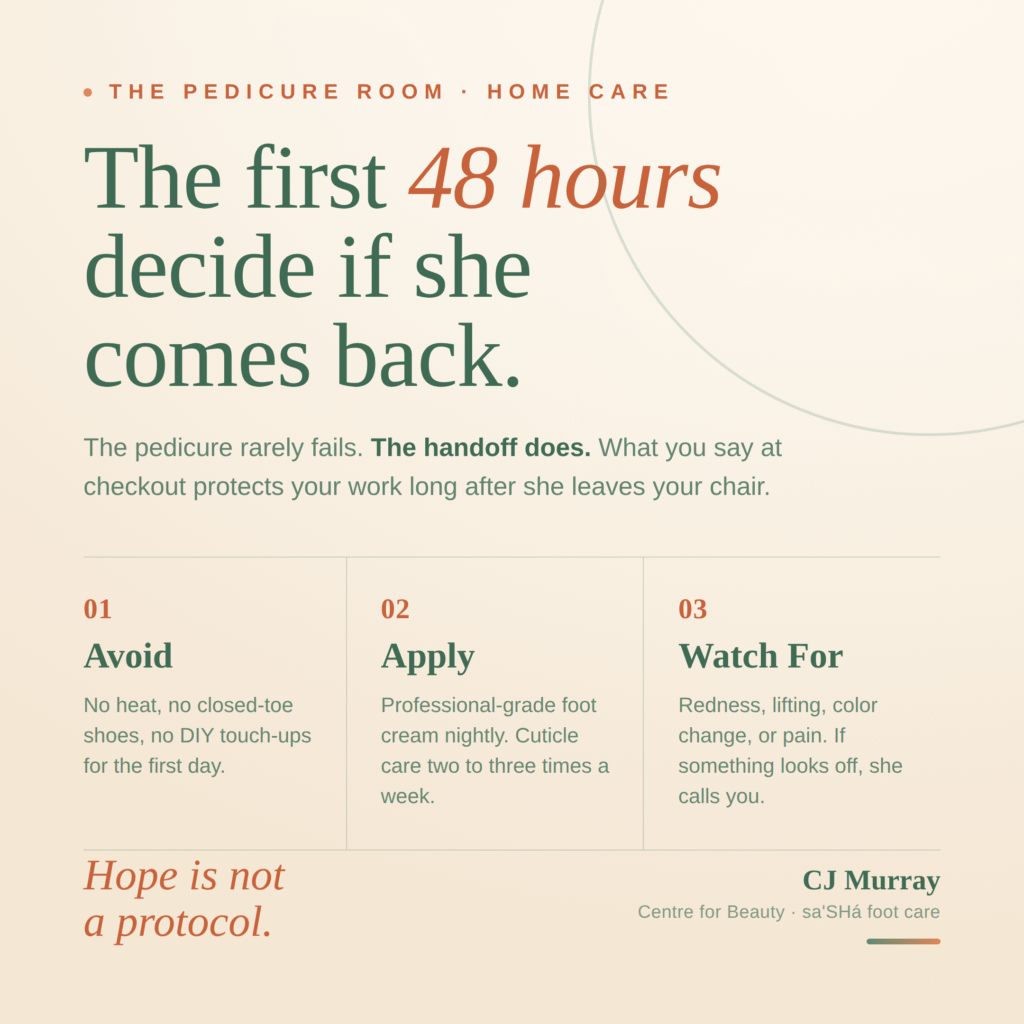
The pedicure didn’t fail. The handoff did.
The first 48 hours after a client leaves your chair determine whether she comes back raving about your work or quietly disappointed by it. And what happens in that window is almost entirely controlled by what you say to her at checkout. Not the polish. Not the soak. Not the massage. The conversation.
This is the most undervalued skill in the pedicure room, and once you start protecting your work the way a surgeon protects a procedure, three things happen. Your retention goes up. Your retail goes up. And your clients start telling their friends that you’re not like the other places they’ve tried.
Let’s talk about what to actually say.
The Three Things Every Client Needs to Hear
The 48-hour conversation is short. Done well, it takes 90 seconds. But it has to cover three specific things, and it has to happen before she pulls out her wallet, because once payment starts, her brain has already left the room.
1. What to Avoid
The first 48 hours are when freshly serviced skin and nails are most vulnerable. Your client doesn’t know this. She thinks the service ended when you put down the polish brush.
Tell her, in plain language:
- No hot baths, hot tubs, or pools for 24 hours. Heat opens pores you just closed and softens skin you just refined. It also weakens polish bonds before they’ve fully cured. (unless its a gel manicure of course)
- No tight or closed-toe shoes for the rest of the day. Pressure against fresh polish is how smudges happen. Applying gel polish? Well, pressure against freshly trimmed cuticles is how irritation happens.
- No DIY touch-ups. If something looks off in 24 hours, she calls you. She doesn’t grab a file or push back a cuticle herself.
You’re not lecturing her. You’re protecting her investment…and yours.
2. What to Apply
This is where most pedicures lose their long-term result. The client walks out with healthy-looking feet and zero plan to keep them that way until her next visit.
Tell her exactly what to apply, when to apply it, and why:
- A professional-grade foot cream, every night before bed. Not the lotion in her bathroom. Not the one that smells nice from the drugstore. A product formulated for the structural needs of foot skin, which is thicker, drier, and under more pressure than skin anywhere else on the body.
- A targeted treatment for any problem area you addressed. Callus, dry heel, thin nail, fungal-prone nail. Whatever you worked on, she needs the at-home version of that protocol or the problem returns faster than her next appointment.
- A cuticle product, two to three times a week. Cuticle health is the single biggest predictor of how good her nails look at her next visit. This includes the toenails.
These aren’t products you’re trying to push, they’re the products built specifically for the protocol you just performed. If a client trusts you to do the service, she should trust you to recommend what protects it.
3. What to Watch For
This is the part most techs skip, and it’s the part that builds the most trust.
Tell her what shouldn’t happen…and what to do if it does:
- If you see redness that doesn’t fade within a day, call us.
- If a nail lifts, separates, or changes color, call us.
- If you feel pain, throbbing, or unusual warmth, call us. And if it’s severe, call your doctor.
That last one matters. You’re not diagnosing anything. You’re giving her a clear framework that says: I care what happens after you leave, and I want to know if something goes wrong.
Most clients have never had a salon professional talk to them this way. The ones who have? They don’t go anywhere else.
Why the 48-Hour Window Drives Retail Attach (Without You Selling)
Here’s what I’ve watched happen to techs who start doing this consistently.
They stop dreading the retail conversation. Because when you’ve just explained to a client that the next 48 hours determine whether her service holds up, recommending the home care that protects it doesn’t feel like selling. It feels like finishing the job.
A client who hears “use any lotion you like” leaves thinking the home care is optional. A client who hears “your feet need a professional-grade cream tonight and every night until I see you again, and here’s the one built for what we just did” leaves thinking the home care is part of the service.
That’s the entire shift. Retail attach isn’t a sales skill. It’s a clinical handoff.
Changing this one mindset, techs go from a 10–15% retail attach rate to 40–50% within a few months. Not because they got better at selling. Because they got better at protecting their own work.
The Take-Home Card
The conversation is the work. But the conversation also has to outlive the appointment, because your client is going to forget half of what you said by the time she gets home.
Send her with something physical. A simple card she can take home with the three sections – Avoid, Apply, Watch For – and your salon’s contact info. Print it on something thicker than copy paper. Make it look like it belongs to her.
When she gets home and her partner asks how the pedicure was, she pulls out the card and shows him. That’s a referral conversation happening without you in the room.
Start Tomorrow Morning
You don’t need a new product line, a new protocol, or a new training to do this. You need 90 seconds at checkout and three specific things to say.
Try it on your next five clients. Watch what happens to your rebook rate. Watch what happens when you recommend home care. Watch the difference in how clients talk to you when they come back.
The 48-hour window is real. It’s already determining the quality of your work in the eyes of every client who leaves your chair. The only question is whether you’re protecting it, or hoping for the best.
Hope is not a protocol.
Ready to take the next step?

CJ Murray is the President of Centre for Beauty, founder of sa’SHá professional foot care products, and a 38-year veteran of the salon industry. She trains licensed professionals across the country in advanced foot care, problem-foot services, and outcome-based pedicure protocols.