As salon professionals, we spend so much of our time perfecting technique, learning new products, and building a service menu that keeps clients coming back. However, there is a category of client sitting in your chair right now that most of our training never prepared us for, and that is the client going through cancer treatment.
You may not even know she is one of them. She may not tell you. However, if you have not had oncology training, there is a real chance you are performing a service on her the same way you would on anyone else, and that is where the risk lives.
It Is Not A Different Pedicure. It Is A Different Read Of The Room.
Oncology training does not hand you a whole new service menu. What it hands you is a different way of reading what is in front of you before you ever pick up an implement.
Skin that looks normal can be dramatically thinner and slower to heal during chemotherapy. Nails that look intact can be more brittle and more prone to lifting or infection. Circulation and sensation can be compromised in ways you cannot see just by looking at a foot. A client with lymphedema carries real risk of infection from even a small nick that would be a non-issue on anyone else. A client who had lymph nodes removes is more at risk than you might know.
Once you understand what is happening inside the body, you start looking at every foot in your chair a little differently. That is the shift. Not a new set of steps. A new set of eyes.
What Actually Changes In The Room
- Your tools and technique. Callus removal, cuticle work, and anything that breaks the skin barrier get reconsidered or eliminated entirely, depending on where the client is in treatment and what her care team has said. This is not about doing less because you are nervous. It is about knowing precisely which techniques are safe and which ones are not, and having the confidence to explain why.
- Your sanitation standards. You already run a clean room. However, an immunocompromised client raises the bar again. Implement sterilization, surface disinfection, and product selection all get a second look through the lens of someone whose body cannot fight off what a healthy client’s body handles without issue.
- Your product choices. Certain ingredients that are perfectly fine for the general public are not appropriate for a client in active treatment. Fragrance, certain essential oils, and specific chemical exfoliants can all be a problem depending on skin sensitivity and treatment stage. This is where product education becomes part of your safety protocol, not just your service menu.
- Your pacing and positioning. Neuropathy changes how a client can position her feet and how much pressure she can tolerate, and she may not be able to tell you in the moment if something is wrong. Fatigue from treatment changes how long she can comfortably sit. The service slows down. The conversation changes. You are reading her body language more than you are running your usual routine.
- Your intake conversation. You start asking questions you were never trained to ask. Where is she in treatment. What has her care team said about circulation and skin integrity. What medications is she on. This is not you playing doctor. This is you gathering the information you need to serve her safely, the same way you would ask about any other condition that changes what is appropriate in your chair.
Why This Belongs In Your Room, Not Just In Your Head
Here is the honest truth. Cancer touches nearly every client base in the country. She is not a rare booking. She may already be on your schedule, and you may not know it because she has not told you, or because she does not yet know herself what is and is not safe for her to receive.
Hope is not a protocol. Good intentions are not a protocol. Wanting to make her feel normal again for forty five minutes is not the same as knowing how to do it without putting her at risk. Oncology training closes that gap. It takes the instinct you already have to take care of people and gives it the clinical foundation to back it up.
The Confidence This Builds
Technicians who complete oncology training consistently say the same thing. It is not just what they stopped doing. It is how much more confident they feel doing everything else. When you know the reasons behind the adjustments, you are not guessing your way through the appointment. You are not silently worried you might be doing harm. You know exactly why you are doing what you are doing, and that confidence is something your client can feel, even if she never knows the specifics of what changed.
That confidence also changes the conversation with every other client in your book. Once you understand skin and circulation at this level, you read every foot more carefully, healthy or not.
Come Learn With Us
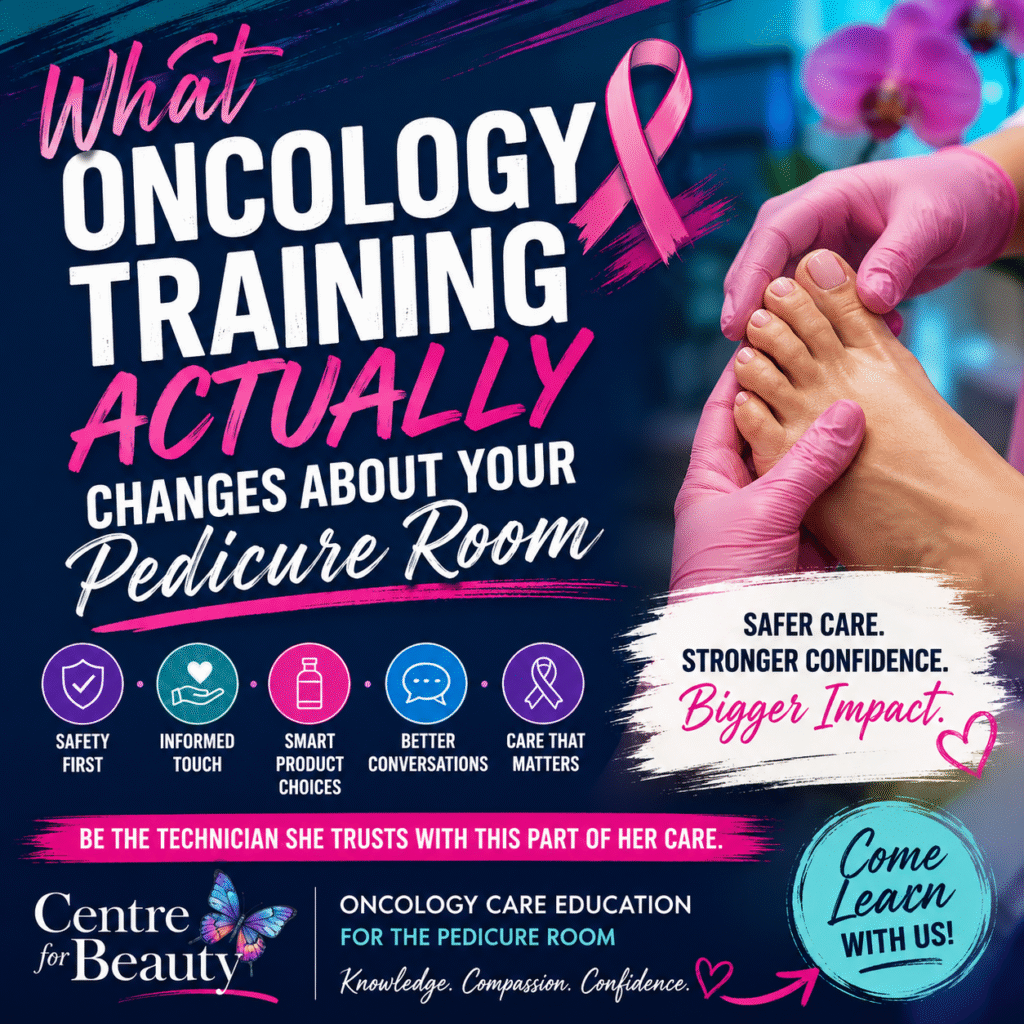
We are building out our oncology care education specifically for the pedicure room, because this is where the training is needed most and where it is hardest to find. If you want to be the technician a client trusts with this part of her care, come learn with us at Centre for Beauty. We will walk through the protocols, the product considerations, and the intake conversations…and more, so you can serve every client in your chair with the confidence she deserves.
Contact cj@centreforbeauty.com for class dates and registration. Or visit our website www.cjscentreforbeauty.com
Changing lives…..in and out of the Pedicure room!