
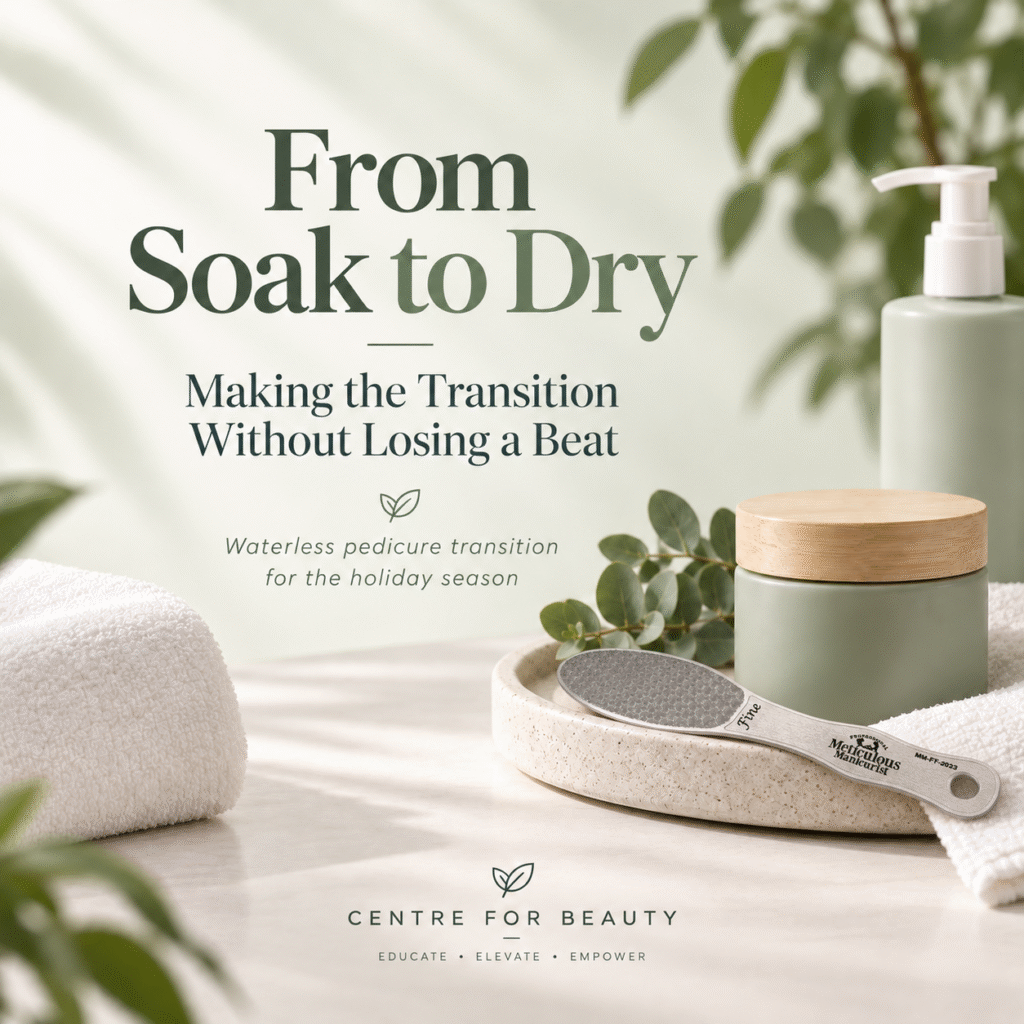
I realize I recently wrote an article on dry pedicures however, I had an overwhelming response with the #1 question being “how do I transition”?
With the holiday season approaching, now is a good time to begin your transition.
From Soak to Dry: Making the Transition Without Losing a Beat
If you have been in the pedicure room for any length of time, you know the sound of the whirlpool filling and the smell of the soak solution hitting warm water. That has been our routine for decades. However, more and more of us are moving toward waterless pedicure protocols, and I want to talk to you honestly about what that shift actually requires.
Here is the good news. Not much has to change.
What Stays The Same
Your service sequence stays intact. You are still doing nail care, cuticle work, callus reduction, exfoliation, and massage. You are still building the same relationship with your client over the same amount of time in the chair. The skills you have spent years developing do not disappear because the water does.
What changes is the delivery method. Instead of softening the skin and nail plate through prolonged water immersion, you are using product to accomplish the same softening, hydrating, and prepping work. A quality softening calls softening product will do the softening for you, without the downsides (which we know of today) that come with soaking.
Why We Are Moving This Direction
Water immersion softens more than skin. It softens the nail plate itself, which can make nails more prone to splitting and can compromise a fresh polish application before it even has a chance to cure properly. Standing water also carries infection control concerns that no amount of jet cleaning fully resolves, especially with clients who have compromised circulation, diabetes, or a history of chemotherapy.
None of this means water pedicures were done wrong. It means we now have more information, better tools, and as those tools improve, our protocols should improve with them.
How To Talk To Your Clients About It
This is the part that makes technicians nervous, and the most frequent question I was asked. Your regular clients trust you. They are not coming in for the whirlpool. They are coming in for you.
Here is language that works:
- “We have updated our pedicure process to a waterless method. Based on updated eduction, we feel it is better for your nails and skin because it avoids over-softening the nail plate, which can lead to splitting and a shorter-lasting polish.”
- “You will get the exact same service you love, cuticle care, callus reduction, massage, and polish. We are just delivering it a different way that is more sanitary and gentler on your skin.”
- “This method is becoming the standard across the industry because it gives us more control and better results for your feet.”
Notice what all three of those have in common. They lead with the client’s benefit, not with your convenience. Clients do not care that waterless service is faster for you to set up or easier to sanitize between appointments, even though it is. They care that it is better for them. Lead with that every time.
A Word On Confidence
Your energy sells this transition more than your words do. If you introduce the change apologetically, as though you are taking something away, your client will feel that hesitation and may push back. However, if you introduce it the way you would introduce any other professional upgrade, a better polish line, a new tool, a refined technique, your client will follow your lead without a second thought.
You have earned that trust. Use it.
The Bottom Line
Waterless pedicures are becoming the norm because they solve real problems: nail plate integrity, sanitation, and service for clients with health considerations that used to require you to skip the soak altogether. It is also easier on the Technician. Making the switch does not mean relearning your craft. It means updating one piece of your process while keeping everything your clients already love about coming to see you.
If you want to build out a full waterless protocol, oncology-informed service considerations, and product selection that supports this transition with confidence, contact CJ at Centre for Beauty. I am always happy to walk through it with you, product by product, step by step.

Outcome based education which drives product selection and confidence.
Dear CJ,
I hope you are doing well, My name is Alfonsina we met at the Premiere Orlando beauty show.
I recently read your article, “Transitioning to Dry Pedicures,” and I truly enjoyed it. The information was very clear, professional, and well explained, and it gave me the confidence to take the next step toward implementing a dry pedicure protocol in my salon.
I am already using the sa’SHá cleaning and sanitation protocols, as well as other professional products purchased from your store. I would now love to receive proper training so I can develop and implement a complete dry pedicure protocol safely and confidently.
Could you please let me know what training or educational program you recommend and what steps I need to take to enroll? I would also appreciate information about upcoming dates, whether the training is offered online or in person, the cost, and any products or equipment I would need.
Thank you very much for your time. I look forward to learning from you and continuing to improve the quality and safety of the services I offer my clients.
Warm regards,
Alfonsina
Hi and WONDERFUL and thank you for your comments and for reaching out. Please e-mail me so I have your email address and yes, I’m sure I can either assist or direct you. cj@centreforbeauty.com