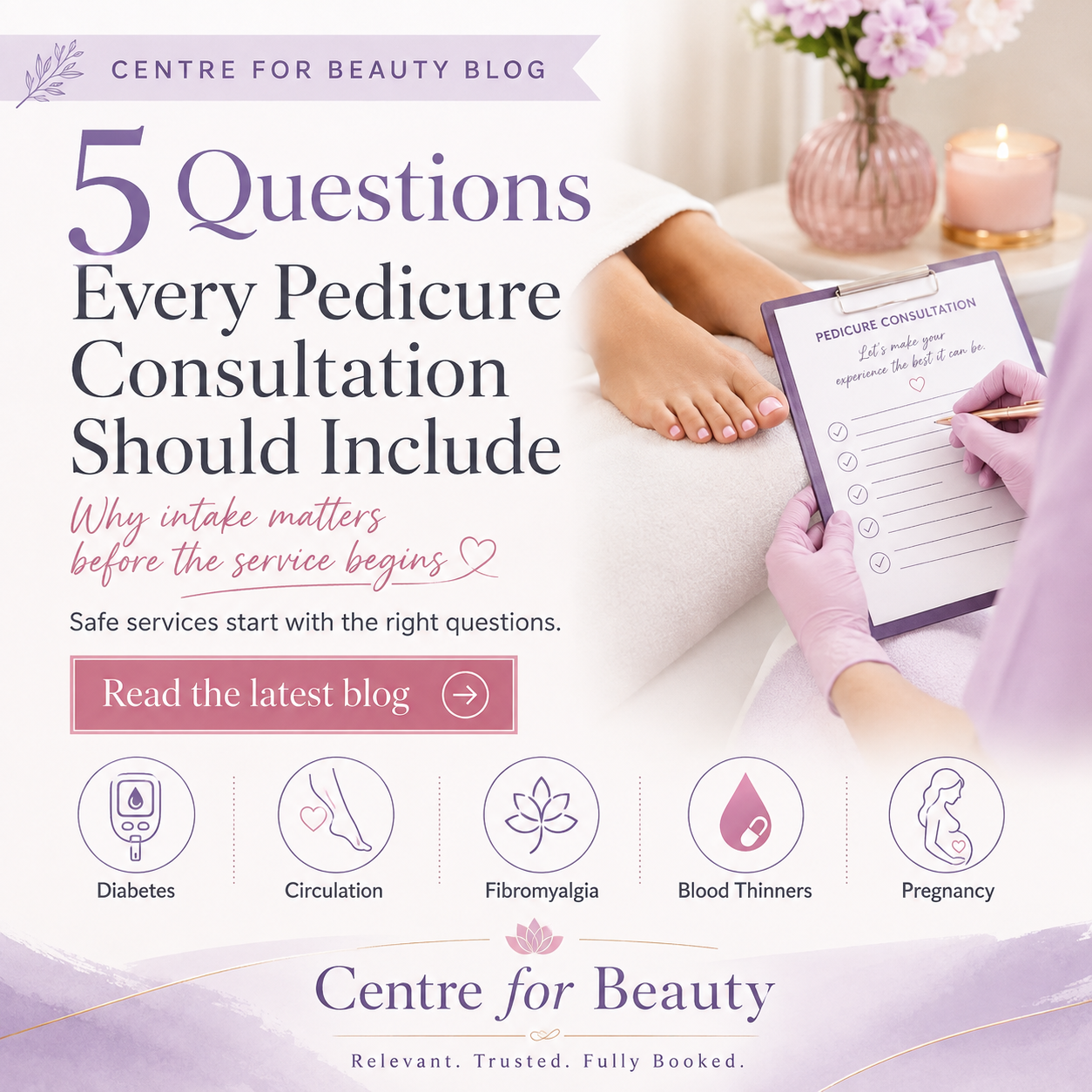
We get busy. The schedule is full, the client sits down, and it is tempting to jump right into soaking feet and moving through the service. However, the few minutes you spend on intake before you ever touch a foot are some of the most important minutes of the entire appointment.
Client consultation is not paperwork. It is the foundation that tells you whether the service in front of you is safe to perform, needs to be modified, or needs to be redirected altogether. Skipping it does not save you time. It puts you and your client at risk.
Here are five(5) questions that belong in every pedicure consultation, and the reasons behind each one.
1. Are You Diabetic?
Diabetes affects circulation and nerve sensation in the feet. A client with diabetes may not feel a nick, a cut, or an area of excess pressure the way another client would. Healing time is also slower, and infection risk is higher.
This does not mean you turn a diabetic client away. It means you adjust your technique. Callus reduction becomes more conservative. Cuticle work becomes more cautious. Sharp implements around compromised skin become a liability instead of a routine tool.
If you skip this question and nick a diabetic client’s skin without knowing their history, you are not looking at a quick bleed and an apology. You are looking at a wound that may not heal properly, a possible infection, and a client whose health outcome was affected by a service that should have protected her.
2. Do You Have Circulatory Problems?
Poor circulation changes everything about how a foot responds to your service. Skin can be thinner and more fragile. Temperature sensitivity changes, which matters the moment you introduce warm water. Healing slows down here too, the same as it does with diabetes.
Clients with circulatory issues often do not think to mention it unless you ask directly. They are not hiding it. It simply does not occur to them that it is relevant to a pedicure. That is on us to ask.
Without this question, you may soak a foot in water that is too warm for compromised circulation, or apply pressure during massage that causes more harm than relaxation. The service you intended as pampering becomes a service that puts your client at risk.
3. Do You Have Fibromyalgia?
Fibromyalgia affects pain sensitivity and tolerance throughout the body, feet included. What feels like light, standard pressure to you may feel like significant pain to a client managing fibromyalgia. Extended time in one position can also increase discomfort.
Knowing this ahead of time lets you adjust your pressure, your pacing, and your positioning before the client is already uncomfortable in the chair. It is far easier to modify your approach from the start than to recover a service after you have already caused pain.
Without asking, you risk a client leaving in more discomfort than when she arrived, and a service that was meant to help her instead became something she has to recover from.
4. Are You on Blood Thinners?
This one carries real, immediate consequences. Blood thinners affect how the body responds to even minor breaks in the skin. What would be a non-event for most clients, a small nick during cuticle work or callus reduction, can become a bleeding situation that is difficult to control on a client taking anticoagulants.
This question changes how conservative you need to be with your implements, and it tells you in advance to have a plan in place if a break in the skin does occur.
Without asking, you find out about the blood thinners after the bleeding has already started, and that is the wrong moment to be gathering this information for the first time.
5. Are You Pregnant?
Pregnancy changes what is appropriate for massage technique, particularly around specific pressure points, and it changes how a client’s body is responding to touch, temperature, and time in a stagnant position. It also opens the door to a broader conversation about foot swelling, circulation changes, and comfort that a pregnant client may genuinely appreciate you asking about.
This is not about liability alone. It is about giving a pregnant client a service that is actually suited to where her body is right now.
Without asking, you may perform massage techniques that are not appropriate for the client’s stage of pregnancy, simply because you did not know there was anything to consider.
What This Conversation Really Protects
Every one of these questions takes seconds to ask. However, what they protect takes a lot longer to repair if you skip them. A skin injury that will not heal. A client in pain who trusted you with her comfort. A bleeding situation you were not prepared for. A technique that was never appropriate for the body in your chair.
Here we go again, hope is not a protocol. You cannot hope a client will mention something important on her own, and you cannot hope nothing goes wrong if you skip the conversation. You ask, every time, with every client, regardless of how many times you have seen her before. Health circumstances change, and a consultation is not a one-time formality. It is an ongoing part of how you practice.
The technicians who last in this industry are not the ones who move fastest through intake. They are the ones who understand that five short questions are what separate a confident, professional pedicure from a service built on assumptions.
However, these are just five(5) questions most technicians don’t even think to ask, outside of maybe “are you diabetic”. We focus so much on the diabetic client, we seem to forget there is a whole lot more immune compromised clients than just those with diabetes.
If you are looking to build out your consultation process or want to go deeper on contraindication knowledge for the pedicure room, contact CJ at Centre for Beauty. I are always glad to talk through what a safe, informed service actually looks like from the first question to the last polish stroke.

Outcome-based education which drives product selection and confidence.