
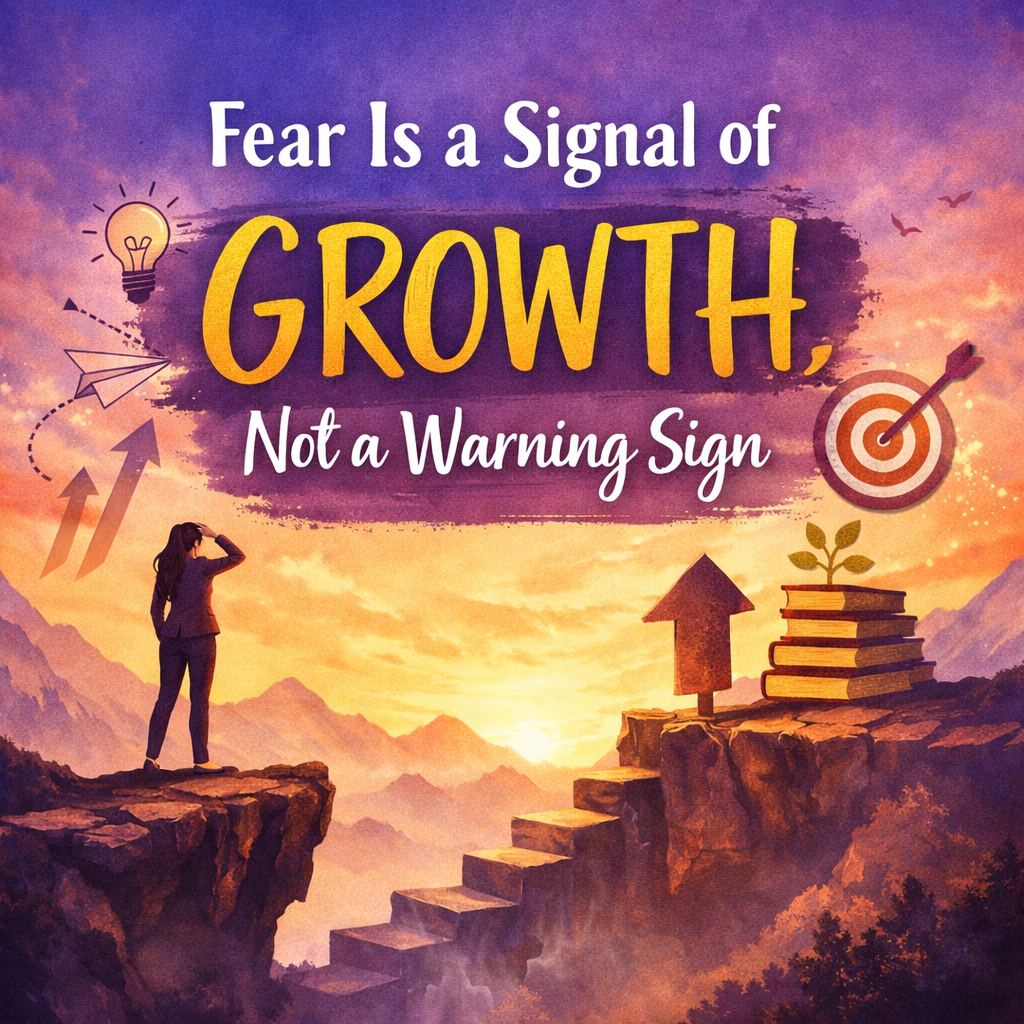
I’m sticking with the theme of growth because it’s the one thing that keeps calling us forward, even when fear, doubt, comfort, and other people’s expectations try to hold us back. While I’ve written about fear before, the truth is our emotions don’t stay fixed; they shift with seasons, circumstances, and the new challenges life keeps handing us. What felt manageable last year might feel heavy today, and that doesn’t mean we’re failing, it means we’re human, still stretching, still learning, and still growing.
I have always said, and still believe….fear WILL hold us back if not recognized for what it is!
Fear Is a Signal of Growth, Not a Warning Sign
Fear gets a bad reputation. We treat it like a flashing red light. Stop, don’t do it, turn back. Yet, in real life (and especially in business), fear is often something else entirely: If managed properly, fear is a signal that you’re stretching, evolving, and stepping into a bigger version of yourself.
The goal isn’t to eliminate fear. The goal is to learn how to read it accurately, so you don’t confuse growth with danger.
Why Fear Shows Up Right Before a Breakthrough
Fear tends to appear when you’re about to do something that matters. Not because it’s wrong…because it’s new. And new means uncertainty.
Growth will ask you to:
- try something you haven’t mastered yet
- be seen before you feel fully ready
- risk hearing “no”
- raise your standards (and your prices)
- lead instead of follow
Fear often shows up right at the edge of your comfort zone like a bouncer at the door: “Are you sure you belong here?”
Here’s the truth: if you never feel nervous, you’re probably not expanding. You’re repeating what’s familiar.
Fear Isn’t Always a Stop Sign…Sometimes It’s a Compass
There are two kinds of fear, and it helps to know the difference.
1) Protective Fear (real warning signs):
This is the fear that keeps you safe. It’s grounded, specific, and tied to a real risk like ignoring your gut about a shady business deal, skipping important sanitation steps, or working beyond your scope of practice.
2) Expanding Fear (growth signals):
This is the fear you feel when your identity is shifting. You’re doing something bigger than you’ve done before: launching a new service, going live, teaching a class, investing in inventory, or finally treating your business like a business.
Expanding fear sounds like:
- “What if I’m not good enough?”
- “What if people judge me?”
- “What if I fail?”
- “What if it doesn’t work?”
That’s not danger…that’s your comfort zone protesting.
The Real Reason Fear Feels So Loud
Fear doesn’t just react to risk. It reacts to change.
When you grow, you’re not only learning new skills, you’re rewriting your self-concept:
- from technician to specialist
- from specialist to educator
- from “I do services” to “I lead outcomes”
- from “I hope they buy” to “I know my value”
Your brain loves predictability. Growth threatens predictability, so fear gets noisy. Not because you’re doing something wrong, but because you’re doing something unfamiliar.
A Better Question Than “How Do I Stop Being Afraid?”
Instead of asking, “How do I get rid of fear?” try asking:
“What is this fear trying to protect me from?”
Sometimes it’s protecting you from embarrassment, rejection, or the discomfort of learning in public. Those are uncomfortable, yet not harmful.
Then ask:
“What would the confident version of me do next…one small step at a time?”
Because confidence isn’t something you wait for. Confidence is something you build by keeping promises to yourself.
How to Use Fear as a Growth Tool
Here are a few ways to turn fear into forward momentum:
- Name it.
Fear is less powerful when it’s specific. “I’m scared” becomes “I’m scared people won’t buy,” or “I’m scared I won’t explain it well.” - Shrink the step.
You don’t have to take the whole leap today. Take the next right step: Remember…..it’s a BIG elephant.-
- draft the post
- outline the class
- price the service
- practice the explanation
- talk to one client
-
- Collect evidence.
Keep a “proof file”. 1)screenshots, 2)wins, 3)kind messages, 4)before/afters. Fear forgets your progress. Evidence reminds you. - Do it scared, but do it smart.
Fear doesn’t mean reckless action. It means informed action:- learn what you need to learn
- set boundaries
- ask questions
- protect your standards
- move anyway
What If Fear Is Actually Confirmation?
Sometimes fear is confirmation that you’re finally taking yourself seriously. You’re raising the bar. You’re stepping out of “good enough.” You’re choosing long-term stability over short-term comfort.
That version of you, the one who follows through, grows skills, builds real confidence…doesn’t arrive without discomfort. So when fear shows up, try saying:
“This isn’t a warning sign. This is the feeling of growth.”
Final Thought
Fear doesn’t always mean stop. Sometimes it means pay attention. You could be standing at the edge of something that could change everything.
If you’re feeling fear right now, it might not be a sign you’re on the wrong path.
It might be proof you’re finally on the one that expands you.
If you’re in that “I want to grow, but I’m nervous” season, pick one thing you’ve been avoiding and take the smallest possible step this week. Then repeat. That’s how momentum is built…one brave decision at a time.

CJ Murray, President
You are preaching to the choir!! Needed this affirmation!
Thanks
Amen! 🙂